
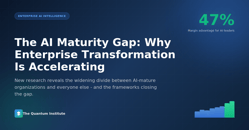
 The divide between AI-mature enterprises and their competitors is widening faster than most executives realize. New research reveals the strategic factors driving this acceleration—and the frameworks organizations are using to close the gap.
The 47% Margin Advantage
Recent analysis of 847 publicly traded companies shows that organizations at advanced stages of AI maturity (stages 4-5) now achieve operating margins 47% higher than those at early stages (1-2). This gap has widened significantly from 21% just eighteen months prior, according to research published in The Corporate Hacker’s Guide 2026.
The data suggests this isn’t a temporary phenomenon. AI capabilities generate data that improves AI performance, which enables new use cases, which generates more data. This compounding effect means early movers build advantages that become increasingly difficult to overcome.
Key findings from the research:
- AI-mature organizations are growing revenue 2.3x faster than less-mature peers
- Companies demonstrating advanced AI capabilities command valuation premiums of 35-45%
- The performance variance between leaders and laggards has expanded to 8.3 standard deviations—unprecedented in modern business history
The Five Stages of AI Maturity
The research identifies five distinct stages of enterprise AI maturity, with clear characteristics at each level:
Stage 1: Exploring (25% of enterprises) Organizations conducting initial AI experiments without production deployments. AI is typically viewed as an IT initiative rather than business transformation, with limited executive engagement.
Stage 2: Implementing (35% of enterprises) Initial production AI systems deployed, but operating in fragmented, project-based mode. Value has been demonstrated but foundations for systematic scaling aren’t yet established.
Stage 3: Scaling (25% of enterprises) Multiple AI systems in production with emerging enterprise coordination. Organizations at this stage are transitioning from AI as projects to AI as capability.
Stage 4: Optimizing (12% of enterprises) AI integrated into core business processes with sophisticated MLOps capabilities. These organizations have moved from asking “where can we use AI?” to “where aren’t we using AI?”
Stage 5: Transforming (3% of enterprises) AI is fundamental to business model and competitive positioning. These organizations don’t just use AI—they compete through AI.
Why Most AI Projects Still Fail
Despite increased investment, research indicates that 70-85% of enterprise AI projects fail to deliver expected value. The pattern emerging from high-profile failures—including IBM Watson Health’s $15 billion in write-downs and Zillow Offers’ $881 million quarterly loss—points to a common cause: investment without strategic framework.
The organizations achieving outsized returns share several characteristics:
- Executive-sponsored governance structures with board-level oversight
- Clear use case prioritization based on business impact and feasibility
- Data infrastructure investments that precede AI deployment
- Talent strategies that address the 3:1 demand-supply gap for experienced practitioners
- Rapid iteration cycles that compress transformation timelines
The 180-Day Transformation Sprint
Leading organizations are abandoning multi-year transformation roadmaps in favor of compressed execution cycles. The “180-Day Transformation Sprint” methodology, documented in recent enterprise research, moves through four phases:
- Foundation (Days 1-30): Governance establishment, readiness assessment, quick-win identification
- Quick Wins (Days 31-90): Initial deployments, value demonstration, organizational confidence building
- Acceleration (Days 91-150): Pilot scaling, use case expansion, operational capability building
- Institutionalization (Days 151-180): Operating model integration, continuous improvement establishment
This approach reflects a broader shift in enterprise thinking: the cost of extended timelines now exceeds the risk of rapid execution.
Sector-Specific Implications
The AI maturity gap manifests differently across industries:
Financial Services: JPMorgan Chase’s AI and data science investments now span fraud detection, trading optimization, and customer service automation. The firm employs over 1,500 data scientists and has documented hundreds of AI use cases in production.
Healthcare: AI applications in diagnostic imaging, drug discovery, and clinical workflow optimization are creating performance divides between health systems that have invested in data infrastructure and those that haven’t.
Manufacturing: Predictive maintenance, quality control, and supply chain optimization represent the highest-impact use cases, with leaders reporting 20-30% reductions in unplanned downtime.
Retail: Personalization, demand forecasting, and inventory optimization are table-stakes capabilities for leading retailers, while laggards struggle with basic data integration.
Geopolitical Factors Accelerating Urgency
The research identifies geopolitical risk as an increasingly central factor in AI strategy. Key considerations for 2026:
- 72% of multinationals are actively restructuring China operations amid US-China technology decoupling
- Taiwan semiconductor concentration represents systemic supply chain risk
- The EU AI Act is creating new compliance requirements that favor organizations with mature governance frameworks
These factors are compressing decision timelines. Organizations that might have pursued gradual AI adoption are now facing pressure to accelerate.
Looking Ahead
The evidence suggests the AI maturity gap will continue widening through 2026 and beyond. For executives evaluating transformation priorities, the research points to several immediate actions:
The window for establishing competitive position is narrowing. Organizations that delay face compounding disadvantage as leaders pull further ahead.
For comprehensive frameworks, assessment tools, and sector-specific implementation guidance, see The Corporate Hacker’s Guide 2026 from The Quantum Institute, available on MarketResearch.com.
About The Quantum Institute: The Quantum Institute is a strategic intelligence research firm providing analysis on AI transformation, cybersecurity, and emerging technology governance to Fortune 500 corporations, government agencies, and institutional investors.